Episode 01. What is "Instrumentation"?
Summary
As plant industry becomes more advanced, the importance of instrumentation is increasing. This episode introduces the concept of instrumentation and phyical values that can be measured. Finally, the general characteristics of instruments are described.
1. Introduction

(Figure 1.1)
There are several instruments installed in plant. Instrument is a device for instrumentation. Then, what is “Instrumentation”? It does not just mean measuring. It is measuring, recoding physical values, or controlling the values to set point.
Why is instrumentation significant? You will set appropriate conditions for manufacturing a product. If these conditions are changed whenever the product is manufactured, the product’s properties are also changed. In addition, production efficiency may be reduced. Instrumentation is a way to check and maintain these proper conditions. As plant industry becomes more advanced, the importance of instrumentation is increasing.
The concept of an instrumentation system is to measure through devices and convert it into an output of the appropriate form. Its concept is simple, but the elements of the system are complex. (e.g., There are sensors, amplifiers, converters, and so on in devices.)
2. Choosing Instruments
Instruments can measure various values. Below things are typical values that can be measured. As various values can be measured, the types of instruments are also diverse. So, we have to choose which things to use.
- Temperature
- Pressure
- Level
- Flowrate
- Voltage
- pH
- etc.
First, it has to know the physical values required by the customer or required for operation in selecting instruments. If some fluids must be stored below a specific temperature, you will select instruments related to temperature. Second, it needs to decide which principle of the instrument to use. There is not just one principle for measuring a specific physical value. Depending on the situation (including capital), it may be necessary to choose an instrument that uses a more appropriate principle. Finally, it needs to select a model and the detailed model’s options according to process or environmental conditions. A detailed explanation of each instrument will be covered in other episodes.
3. Typical Characteristics
As mentioned, even if you decide on the principles to use, it is not the end. There are many things to consider by looking at the product catalogs of the instrument manufacturers. Now let’s know some of the characteristics of instruments that need to consider.
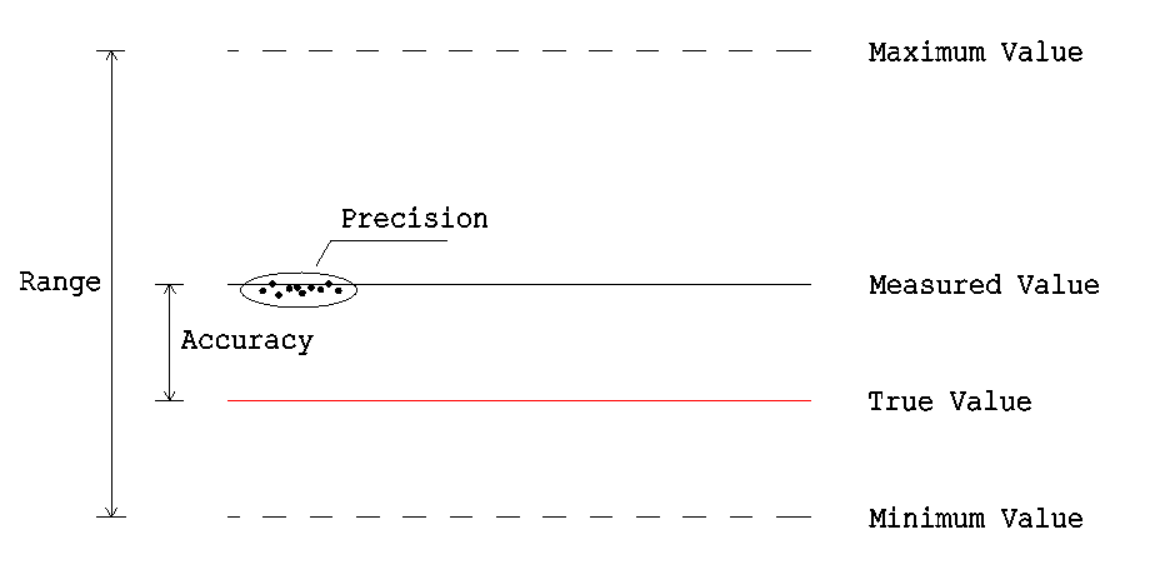
(Figure 1.2)
Range
Instruments have maximum value and minimum value that they can measure.
Accuracy
It is difficult to measure the true value accurately. Therefore, instruments have a characteristic called accuracy. There are a measured value and true value in (Figure 1.2). Accuracy means how close the measured value is to the true value. In other words, the higher accuracy, the smaller difference between the measured value and the true value.
Precision
Precision describes the distribution of outputs from multiple measurements of the same input. Precision can describe as “repeatability” and “reproducibility”. Repeatability means how close the outputs are when the same input is measured multiple times under the same conditions (e.g., location, observer, instrument, etc.) and a short period. Reproducibility is how close the outputs are when the same input is measured multiple times under changed conditions over a long period. It should note that high precision does not mean high accuracy.