Episode 01. Thermodynamic Laws and Property Relations
Summary
Thermodynamics allows us to analyze and predict various phenomena. In this episode, we describe the fundamental information required for understanding thermodynamics. Firstly, we discuss the definition and types of systems and the laws of thermodynamics. Finally, we summarize the relationships among thermodynamic properties.
1. Introduction
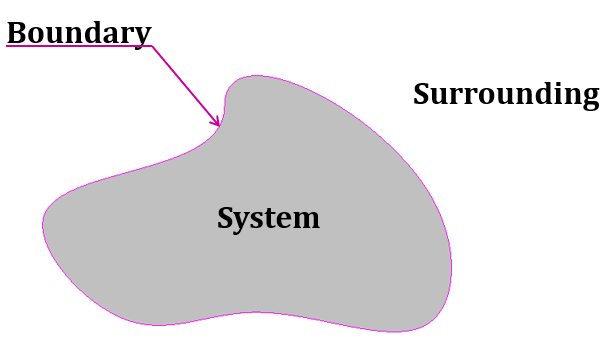
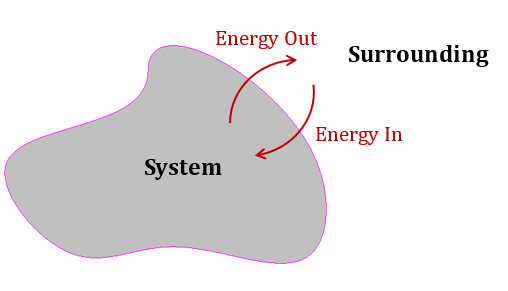
Through thermodynamics, we can comprehend various phenomena and predict the direction in which a system will proceed based on principles and properties. Before dealing with thermodynamics principles and properties, we need to understand the concept of a system. By setting a system, we can determine its state and apply thermodynamic equations. Based on the boundary, we classify the region we observe or control as the system and the region excluding the system area as the surrounding. There are various types of systems, including closed systems, open systems, and isolated systems which are determined by the exchange of material and energy between the system and its surrounding region.
Closed System
A system in which the material does not enter or exit the system, but energy is exchangeable.

Open System
A system in which both material and energy can enter or exit.

Isolated System
A system where neither material nor energy can enter or exit.
(Figure 1.1)
2. The laws of the thermodynamics
The zeroth law of thermodynamics
The zeroth law of thermodynamics states that if A and B (objects or systems) are in thermal equilibrium with C (object or system), it implies that A and B are also in thermal equilibrium with each other.
The first law of thermodynamics
The first law of thermodynamics states that energy is conserved while it can change forms. In other words, although the quantities and types of energy within the system and the surrounding can change, their sum remains constant. This can be expressed mathematically as (Eq 1.1).
\( {\small\displaystyle\begin{align} ΔE_{system}\,+\,ΔE_{surrounding} \quad=\quad 0 \tag{Eq 1.1} \end{align} } \)
Let’s apply the first law of thermodynmics to a closed system. As it is a closed system, only energy in the form of heat(Q) and work(W) can enter or exit the system. Furthermore, if we consider that there is only the internal energy(U) change in the
system, it can be represented as (Eq 1.2).
\( {\small\displaystyle\begin{align} ΔU_{system} \quad=\quad Q\,+\,W \tag{Eq 1.2} \end{align} } \)
The second law of thermodynamics
The second law of thermodynamics states that entropy change is always non-negative. In other words, there are no processes where the total entropy decreases. The term “entropy” (S) refers to one of the thermodynamic properties related to heat and temperature. Its differential change is defined as shown in (Eq 1.4).
\( {\small\displaystyle\begin{align} ΔS_{t} \quad&≥\quad 0 \tag{Eq 1.3} \\[15pt] dS_{system} \quad&=\quad \frac{dQ_{rev}}{T} \tag{Eq 1.4} \end{align} } \)
The third law of thermodynamics
The third law of thermodynamics states that as the temperature approaches absolute zero(0K), the total entropy change also approaches zero. At absolute zero temperature, the entropy of a perfect crystalline substance is zero.
\( {\small\displaystyle\begin{align} \lim_{T\to 0K}S \quad=\quad 0 \tag{Eq 1.5} \end{align} } \)
3. Thermodynamic properties and fundamental relations
There are two types of properties: extensive properties and intensive properties. An extensive property increases its value in proportion to the size of the system, such as volume(V), internal energy(U), enthalpy(H), entropy(S), and gibbs free energy(G). In contrast, an intensive property does not depend on the size of the system. In other words, the value remains constant regardless of the size of the system. (e.g., temperature(T), pressure(P), and density(ρ)) For extensive properites, we can express the following equation.
For extensive properties, we can express like the following equation.
\( {\small\displaystyle\begin{align} M_t \quad=\quad mM \quad or\quad nM \tag{Eq 1.6} \end{align} } \)
Some properties are defined as
\( {\small\displaystyle\begin{align} H \quad&\equiv\quad U\,+\,PV \tag{Eq 1.7} \\[15pt] A \quad&\equiv\quad U\,-\,TS \tag{Eq 1.8} \\[15pt] G \quad&\equiv\quad H\,-\,TS \tag{Eq 1.9} \end{align} } \)
Through differential changes and mathematical methods, we can derive various relationships. Let’s explore the relationships among properties in a closed system. Assuming no chemical reactions and a single phase, we can summarize the relevant equations for internal energy, enthalpy, Helmholtz free energy, and Gibbs free energy as shown in (Table 1.1).
| \({\small\text{Internal Energy},\,U}\) | \({\small\text{Enthalpy},\,H}\) | \({\small\text{Helmholtz Free Energy},\,A}\) | \({\small\text{Gibbs Free Energy},\,G}\) | ||||
|---|---|---|---|---|---|---|---|
| \({\small d(nU)\,=\,dQ_{rev}\,+\,dW_{rev}}\) | \({\small\text{(Eq 1.10)}}\) | \({\small d(nH)\,=\,d(nU)\,+\,d(PnV)}\) | \({\small\text{(Eq 1.13)}}\) | \({\small d(nA)\,=\,d(nU)\,-\,d(TnS)}\) | \({\small\text{(Eq 1.16)}}\) | \({\small d(nG)\,=\,d(nH)\,-\,d(TnS)}\) | \({\small\text{(Eq 1.19)}}\) |
| \({\small d(nU)\,=\,Td(nS)\,-\,Pd(nV)}\) | \({\small\text{(Eq 1.11)}}\) | \({\small d(nH)\,=\,Td(nS)\,+\,nVdP}\) | \({\small\text{(Eq 1.14)}}\) | \({\small d(nA)\,=\,-nSdT\,-\,Pd(nV)}\) | \({\small\text{(Eq 1.17)}}\) | \({\small d(nG)\,=\,nVdP\,-\,nSdT}\) | \({\small\text{(Eq 1.20)}}\) |
| \({\small dU\,=\,TdS\,-\,PdV}\) | \({\small\text{(Eq 1.12)}}\) | \({\small dH\,=\,TdS\,+\,VdP}\) | \({\small\text{(Eq 1.15)}}\) | \({\small dA\,=\,-SdT\,-\,PdV}\) | \({\small\text{(Eq 1.18)}}\) | \({\small dG\,=\,VdP\,-\,SdT}\) | \({\small\text{(Eq 1.21)}}\) |
Let’s take a closer look at the derivation process of the equations presented in (Table 1.1) using enthalpy as an example. By substituting d(nU) with (Eq 1.11), we can observe that it yields the expression (Eq 1.14). Similarly, we can obtain other properties through the same process. And the last row of the table above is the equations for n = 1.
\( {\small\displaystyle\begin{align} d(nH) \quad&=\quad d(nU)\,+\,d(PnV) \\[15pt] &=\quad d(nU)\,+\,Pd(nV)\,+\,nVdP \\[15pt] &=\quad Td(nS)\,-\,Pd(nV)\,+\,Pd(nV)\,+\,nVdP \\[15pt] &=\quad Td(nS)\,+\,nVdP \tag*{} \end{align} } \)
Now, let’s consider the case of an open system, where the exchange of material is possible.
Based on (Eq 1.11), we can observe that the internal energy U is a function of entropy S and volume V. Moreover, in the case of an open system, it becomes a function of mole numbers. Therefore, we can express this relationship as follows.
\( {\small\displaystyle\begin{align} nU \quad&=\quad f(nS,\,nV,\,n_1,\,n_2,\,…n_i\,…) \\[15pt] d(nU) \quad&=\quad \left[\frac{\partial{(nU)}}{\partial{(nS)}}\right]_{V,n}dS\,+\,\left[\frac{\partial{(nU)}}{\partial{(nV)}}\right]_{S,n}dV\,+\,\sum_i\left[\frac{\partial{(nU)}}{\partial{n_i}}\right]_{S,V,n_j}dn_i \\[15pt] μ_i \quad&\equiv\quad \left[\frac{\partial{(nU)}}{\partial{n_i}}\right]_{S,V,n_j} \tag{Eq 1.22} \\[15pt] d(nU) \quad&=\quad Td(nS)\,-\,Pd(nV)\,+\sum_iμ_idn_i \tag{Eq 1.23} \end{align} } \)
We refer to μi as the chemical potential which can be related to not only internal energy but also other properties. If we relate the chemical potential to the Gibbs free energy, we arrive at (Eq 1.25).
\( {\small\displaystyle\begin{align} d(nG) \quad&=\quad d(nU)\,+\,d(PnV)\,-\,d(TnS) \\[15pt] d(nG) \quad&=\quad (nV)dP\,-\,(nS)dT\,+\,\sum_iμ_idn_i \tag{Eq 1.24} \\[15pt] nG \quad&=\quad f(P,\,T,\,n_1,n_2,…,\,n_i,\,…) \\[15pt] d(nG) \quad&=\quad \left[\frac{\partial(nG)}{\partial P}\right]_{T,n}dP\,+\,\left[\frac{\partial(nG)}{\partial T}\right]_{P,n}dP\,+\,\sum_i\left[\frac{\partial(nG)}{\partial n_i}\right]_{P,T,n_j}dn_i \\[15pt] &\longrightarrow\quad μ_i \quad=\quad \left[\frac{\partial(nG)}{\partial n_i}\right]_{P,T,n_j} \tag{Eq 1.25} \end{align} } \)
Nomenclature
\({\small\displaystyle A}\) : Helmholtz free energy
\({\small\displaystyle E}\) : energy
\({\small\displaystyle G}\) : Gibbs free energy
\({\small\displaystyle H}\) : enthalpy
\({\small\displaystyle m}\) : mass
\({\small\displaystyle n}\) : mole numbers
\({\small\displaystyle P}\) : pressure
\({\small\displaystyle Q}\) : heat
\({\small\displaystyle S}\) : entropy
\({\small\displaystyle T}\) : temperature
\({\small\displaystyle U}\) : internal energy
\({\small\displaystyle V}\) : volume
\({\small\displaystyle W}\) : work
\({\small\displaystyle \mu}\) : chemical potential