
Episode 01. Types of Heat Transfer
Summary
In industrial systems, temperature is a critical process variable, affecting equipment performance and process efficiency. Achieving the desired temperature requires an understanding of heat transfer principles. In this episode, we provide an overview of the three modes of heat transfer and their fundamental characteristics.
1. Introduction
Temperature is a critical process variable in plant operations. To ensure the smooth operation of various equipment, systems are designed to maintain fluid inlet and outlet temperatures within a specific temperature range. Depending on the operational requirements, heat transfer is accomplished using process fluids or utilities such as cooling water, oil, or steam. Based on heat transfer theory, we can analyze the mechanisms of heat transfer and determine the surface area required to achieve a desired heat exchange rate.
Heat transfer refers to the movement of energy from regions of higher temperature to lower temperature, driven by a temperature gradient. There are three primary modes of heat transfer: conduction, convection, and radiation. In many real-world applications, two or three modes occur simultaneously, contributing to the overall heat transfer process. This episode provides an overview of the key characteristics of each mode.
2. Three types of heat transfer

(Figure 1.1)
Conduction
Conduction refers to the transfer of heat within a material or between adjacent materials caused by a temperature difference without any bulk movement of the material. This mode of heat transfer primarily occurs in solids. The rate of heat by conduction is proportional to the temperature gradient, a relationship described by Fourier’s Law.
\( {\small\displaystyle\begin{align} \dot{Q} \quad=\quad -kA\frac{dT}{dx} \tag{Eq 1.1} \end{align} } \)
(Eq 1.1) represents the equation for steady-state conduction in the x-direction, where \({\small\displaystyle k}\) denotes the thermal conductivity.
(Figure 1.2)
Convection
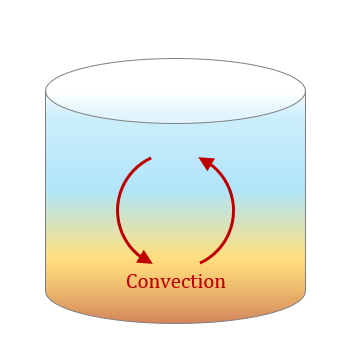
Convection is the transfer of heat resulting from the motion and mixing of fluid regions at different temperatures. This mode of heat transfer primarily occurs in fluids and is categorized as either natural or forced convection. Natural convection is driven by density or temperature gradients, while forced convection involves externally induced flow using mechanical devices such as pumps or agitators.
According to Newton’s Law of Cooling, the rate of heat loss is proportional to the temperature difference between an object and its surroundings. This relationship allows convective heat transfer to be expressed mathematically by (Eq 1.2), where \({\small\displaystyle h}\) represents the heat transfer coefficient.
\( {\small\displaystyle\begin{align} \dot{Q} \quad=\quad hAdT \tag{Eq 1.2} \end{align} } \)
(Figure 1.3)
Radiation
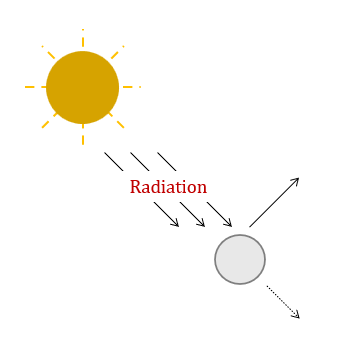
Radiation refers to the transfer of thermal energy via electromagnetic waves. This mode of heat transfer, unlike conduction or convection, can occur in a vacuum as it requires no medium. A classic example is the transfer of solar energy from the sun to the Earth. When radiation encounters matter, some of the energy is absorbed, some is transmitted, and some is reflected. This process can be described by the following equation. In (Eq 1.3), \({\small\displaystyle \alpha}\) is absorptivity, \({\small\displaystyle \gamma}\) is reflectivity, and \({\small\displaystyle \tau}\) is transmissivity.
\( {\small\displaystyle\begin{align} \alpha \,+\, \gamma \,+\, \tau \quad=\quad 1 \tag{Eq 1.3} \end{align} } \)
The absorbed radiant energy is converted into heat, which can be calculated using (Eq 1.4) based on the Stefan-Boltzmann law. This equation incorporates the emissivity(\({\small\displaystyle \epsilon}\)), defined as the ratio of actual emissive power to that of a blackbody at the same temperature. In (Eq 1.4), sigma represents the Stefan-Boltzmann constant.
\( {\small\displaystyle\begin{align} \dot{Q} \quad=\quad \sigma\epsilon AT^4 \tag{Eq 1.4} \end{align} } \)
The three modes of heat transfer – conduction, convection, and radiation – each have distinct characteristics and often work together in various scenarios. Understanding these mechanisms enables more efficient energy management and broader application across different fields. Each mode will be explored in more detail in subsequent episodes.
Nomenclature
\({\small\displaystyle A}\) : area
\({\small\displaystyle h}\) : hear transfer coefficient
\({\small\displaystyle k}\) : thermal conductivity
\({\small\displaystyle \dot{Q}}\) : the rate of heat
\({\small\displaystyle T}\) : temperature
\({\small\displaystyle \alpha}\) : absorptivity
\({\small\displaystyle \gamma}\) : reflectivity
\({\small\displaystyle \epsilon}\) : emissivity
\({\small\displaystyle \sigma}\) : Stefan-Boltzmann constant
\({\small\displaystyle \tau}\) : transmissivity