
Episode 03. RTD sensor
Summary
Due to various advantages such as wide measuring range and stability, RTD sensors are one of the most common thermometers in the industry. In this episode, we explain the working principle and types of RTD sensors, as well as some specifications when selecting them.
1. Working Principle of RTD Sensor
RTD (Resistance Temperature Detector) is one of the most used temperature sensors in the industry. The principle of operation is to measure resistance as a function of temperature. The resistance of metals used in RTD sensors increases as the temperature rises and decreases as the temperature decreases. Expressing this, it becomes (Eq 3.1). Approximating (Eq 3.1) as a linear equation, we get (Eq 3.2)
\( {\small\displaystyle \begin{align} R_T \quad&=\quad R_0(1\;+\;\alpha T\;+\;\beta T^2\;+\;\gamma T^3\;+\;\cdots) \tag{Eq 3.1} \\[15pt] R_T \quad&\approx\quad R_0(1\;+\;\alpha T) \tag{Eq 3.2} \end{align} } \)
The α in (Eq 3.2) is called the temperature coefficient of resistance, and its value is based on 0°C and 100°C.
\( {\small\displaystyle \begin{align} \alpha \quad=\quad \frac{R_{100}\;-\;R_0}{100\;\times\;R_0} \tag{Eq 3.3} \end{align} } \)
The α is from the linear equation. To utilize it, the resistance change according to the temperature of the metal must satisfy a linear. Typical metals that exhibit linearity are platinum, nickel, copper, and so on. Recently, RTD sensors mainly use platinum. Platinum has various advantages, such as a wide temperature range, stability, and repeatability.
We can come across Pt100 (or Pt1000) when looking at the specifications of RTD sensors. Pt 100 (or Pt 1000) means that the metal used in the senor is platinum, and when measuring resistance at 0°C, 100 (or 1000) ohm[Ω] come out.
2. Specifications of RTD Sensor
When selecting an RTD sensor, we determine the specifications. They are determined by various considerations such as process conditions, installation location, and environment. We describe some of these speicificaitons.

(Figure 3.1)
Sensing Element Type : Wire-Wound vs Thin-Film
Typically used in industry, there are wire-wound type and thin-film type.
– Wire-Wound Type
Wire-wound type is a form in which wire is wound around a ceramic(or glass) tube. In particular, the accuracy for high temperature is better than the thin-film type.
– Thin-Film Type
Thin-film type is a form in which a platinum resistance pattern is attached to a rectangular substrate. This type is relatively inexpensive compared to the wire-wound type. However, the accuracy may decrease when used at high temperatures.
Thermowell:
We often install thermowell to protect sensors. By mounting the thermowell, the sensor can avoid direct fluid contact. Therefore, it increases the stability of sensors. As well as maintenance is possible during operation. However, when using a thermowell, the response time increases relatively.
Immersion Length
The immersion length (U) of the RTD sensor is related to the installation. Of course, we have to install it so that the temperature to be measured is representative. If the immersion length is too short, it can be an error factor because it can be affected by the conduction of the equipment or pipe.
For installation in a pipe, for example, it is recommended to place the sensor element on the centerline of the pipe. Therefore, the immersion length must be more than half of the pipe’s inner diameter. It needs to check if there is a national standard for installation.
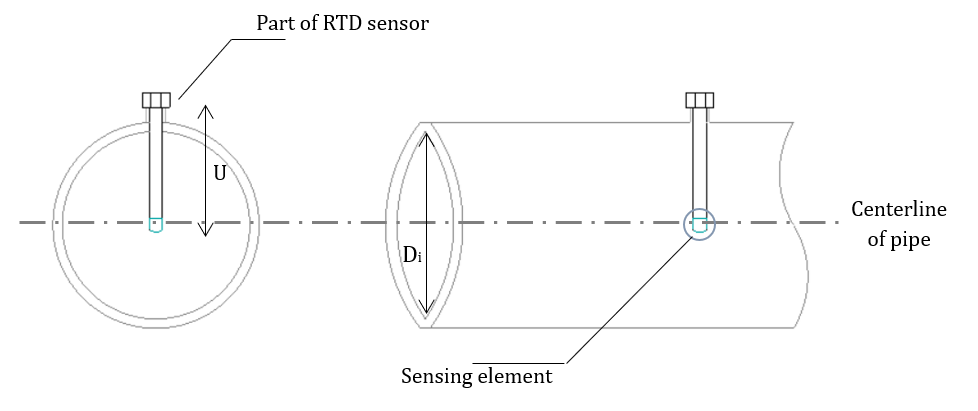
(Figure 3.2)
3. Error Factors of RTD Sensor
When measuring temperature with an RTD sensor, errors occur due to the following factors.
– Lead Wire Resistance Error
There is not only resistance by measured temperature, but also the resistance of the lead wire itself. We can reduce the error caused by the lead wire through the wiring connection method. There are 2–wire, 3–wire, and 4–wire methods for wiring. 2 – wire connection cannot compensate for the error. So, this method is poorly used except when the lead wire is short. To compensate for this error, 3–wire connection is usually used, and a 4-wire connection is used when a more accurate value is required.
– Self-Heating Error
There is energy when current flows through a wire with resistance. Because of this energy (or heat), it may measure higher than the actual temperature.
Nomenclature
\({\small\displaystyle D_i}\) : inner diameter
\({\small\displaystyle R}\) : resistance
\({\small\displaystyle R_T}\) : resistance at the temperature
\({\small\displaystyle \mathrm{RTD}}\) : resistance temperature detector
\({\small\displaystyle U}\) : immersion length
\({\small\displaystyle \alpha}\) : temperature coefficient of resistance