Episode 04. Heat Balance with Reaction
Summary
The heat of reaction plays a significant role in heat (or energy) balance calculations. In this episode, we introduce the standard heat of formation and standard heat of reaction. And we discuss how to calculate the heat of reaction at a specific temperature. Finally, we describe how to calculate the heat balance with reaction through an example.
1. Introduction
Reactions can be classified into exothermic reactions and endothermic reactions. To determine whether a reaction is exothermic or endothermic, we need to calculate the enthalpy of reaction. If the enthalpy is a negative value, it is an exothermic reaction. And if it is a positive value, it is an endothermic reaction. The heat of reaction plays a significant role in heat (or energy) balance calculations. Neglecting the heat of reaction when calculating heat balances in reactive operations, particularly in reactors, can lead to errors in determining temperatures, required heating or cooling media quantities, and overall energy transfer. So, how can we calculate the heat balance with reaction? To calculate this, let’s look at the following information.
Standard heat of formation
The standard heat of formation refers to the enthalpy change required to produce 1 mole of products from its constituent elements under standard state conditions(25°C, 1atm). Here is an example of calculating the standard heat of formation for AB. The standard heat of formation for elements is defined as 0. Hence, the standard heat of formation for A2 and B2 in the given reaction is also 0. The symbol (°) indicates the standard state and the symbol (ˆ) means the value is per mole.
\( {\small\displaystyle\begin{align} A_2\,+\,B_2 \quad\longrightarrow\quad 2AB \tag*{} \end{align} } \)
\( {\small\displaystyle\begin{align} Q \quad&=\quad Δ\hat{H}°_{f, AB} \,-\, \frac{1}{2}Δ\hat{H}°_{f, A_2} \,-\, \frac{1}{2}Δ\hat{H}°_{f, B_2} \\[15pt] &=\quad Δ\hat{H}°_{f, AB} \,-\,0\,-\,0 \\[15pt] &=\quad Δ\hat{H}°_{f, AB} \tag*{} \end{align} } \)
Standard heat of reaction
If we know the standard heat of formation for the reactants and products, we can calculate the standard heat of reaction. This value is determined by the difference between the standard heat of formation for the products and reactants in the reaction equation when the reaction occurs completely under standard conditions. Based on the following reaction equation, we can calculate the standard heat of reaction as follows.
\( {\small\displaystyle\begin{align} AB\,+\,2B_2 \quad\longrightarrow\quad AB_2\,+\,\frac{1}{2}B_2 \tag*{} \end{align} } \)
\( {\small\displaystyle\begin{align} ΔH°_{rxn} \quad&=\quad n_{AB_2}Δ\hat{H}°_{f,AB_2}\,+\, n_{B_2}Δ\hat{H}°_{f,B_2}\,-\, n_{AB}Δ\hat{H}°_{f, AB}\,-\, n_{B_2}Δ\hat{H}°_{B_2} \\[15pt] &=\quad 1\cdotΔ\hat{H}°_{f,AB_2}\,+\, \frac{1}{2}\cdotΔ\hat{H}°_{f,B_2}\,-\, 1\cdotΔ\hat{H}°_{f,AB}\,-\, 2\cdotΔ\hat{H}°_{f,B_2} \\[15pt] &\quad(\text{If}\,n_{AB}\quad=\quad\text{1 mol}) \tag*{} \end{align} } \)
The calculation of the standard heat of reaction can be summarized in a general form (Eq 4.1).
\( {\small\displaystyle\begin{align} ΔH°_{rxn} \quad=&\quad \sum_i^{Products} v_iΔ\hat{H}°_{f,i}\,-\, \sum_i^{Reactants}|v_i|Δ\hat{H}°_{f,i} \\[15pt] =&\quad\sum_iv_iΔ\hat{H}°_{f,i} \tag{Eq 4.1} \end{align} } \)
Reactions are not always perfectly complete. Thus, the heat of reaction also differs when it does not react perfectly. To calculate this, we utilize the extent of reaction discussed in Episode 02. By using the equation relating to the extent of reaction, we can express the heat of reaction under the standard state when the reaction has occurred partially, as shown in (Eq 4.2).
\( {\small\displaystyle\begin{align} ΔH_{rxn} \quad&=\quad \sum_in^f_iΔ\hat{H}°_{f,i}\,-\, \sum_in^i_iΔ\hat{H}°_{f,i} \\[15pt] &=\quad \sum_i(n^i_i\,+\,v_iξ)Δ\hat{H}°_{f,i}\,-\, \sum_in^i_iΔ\hat{H}°_{f,i} \\[15pt] &=\quad\sum_iv_iξΔ\hat{H}°_{f,i} \tag{Eq 4.2} \end{align} } \)
2. Calculation heat of reaction at T
In many cases, reactions occur under conditions that are not standard state. So how do we calculate the heat of reaction in such situations? When we know the heat capacities, latent heat, and standard heat of formation for each component, we can utilize the fact that enthalpy is a state function. The key feature of a state function is that it has the same value regardless of the path taken.
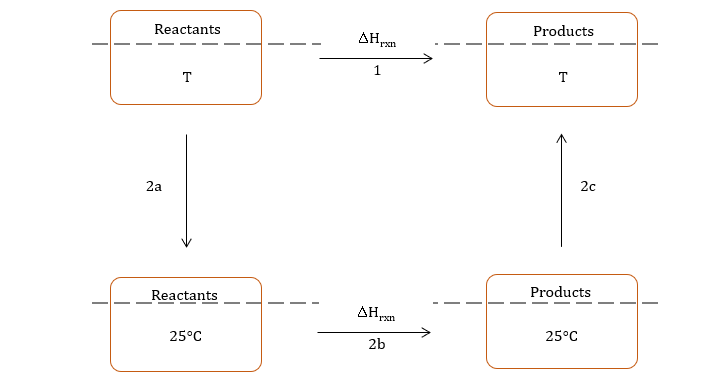
Let’s take a look at (Figure 4.1). We want to calculate the heat of reaction at a specific temperature T (Path 1). According to the characteristic of state functions, the enthalpy change for path 1 and path 2 should be equal.
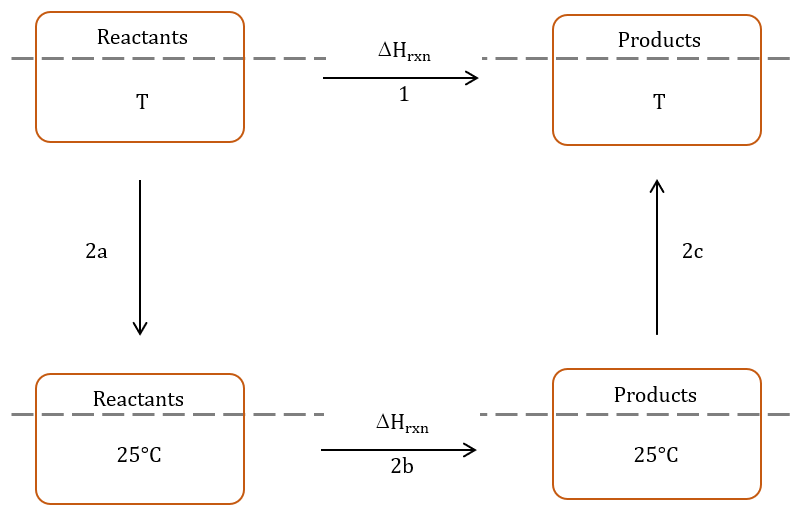
(Figure 4.1)
\( {\small\displaystyle ΔH_{rxn} \quad=\quad ΔH_{2a}\,+\,ΔH_{2b}\,+\,ΔH_{2c} } \)
The enthalpy change for each section of Path 2 is summarized as follows.
\( {\small\displaystyle\begin{align} ΔH_{2a} \quad&=\quad \sum_i^{Reactants}n_i[\hat{H}_i(\text{at 25°C})\,-\,\hat{H}_i(\text{at T})] \\[15pt] ΔH_{2b} \quad&=\quad ΔH_{rxn}(\text{at 25°C}) \\[15pt] ΔH_{2c} \quad&=\quad \sum_i^{Products}n_i[\hat{H}_i(\text{at T})\,-\,\hat{H}_i(\text{at 25°C})] \\[15pt] &\text{Note :}\quad \hat{H}_i(\text{at}\,T_2)\,-\,\hat{H}_i(\text{at}\,T_1) \quad=\quad \int_{T_1}^{T_2} C_{P,i} dT\,+\,λ_i \end{align} } \)
Therefore,
\( {\small\displaystyle\begin{matrix} ΔH_{rxn}(\text{at T}) \quad=\quad \displaystyle\sum_i^{Reactants}n_i[\hat{H}_i(\text{at 25°C})\,-\,\hat{H}_i(\text{at T})] \,+\, ΔH_{rxn}(\text{at 25°C}) \,+\, \sum_i^{Products}n_i[\hat{H}_i(\text{at T})\,-\,\hat{H}_i(\text{at 25°C})] &\text{(Eq 4.3)} \end{matrix} } \)
Now let’s apply it to a flow system. In (Eq 3.2) from the previous episode, we omitted ΔHrxn since there is no reaction. However, in a system with reactions, we need to consider the heat of reaction in the system. In order to consider this, we can include the heat of formation in each flow. Then we can represent (Eq 3.2) as (Eq 4.4). (Eq 4.4) is based on a molar basis.
By replacing “Products” with “out” and “Reactants” with “in” in (Eq 4.3) and assuming a reference temperature of 25°C, we can express the heat of reaction as (Eq 4.5).
\( {\small\displaystyle\begin{matrix} (ΔH_{in}\,+\,E_{K,in}\,+\,E_{P,in}\,+\,ΔH°_{f,in}) \,-\, (ΔH_{out}\,+\,E_{K,out}\,+\,E_{P,out}\,+\,ΔH°_{f,out}) \,+\, Q\,+\,W \quad=\quad (U\,+\,E_K\,+\,E_P)_{accumulation} &\text{(Eq 4.4)} \end{matrix} } \)
\( {\small\displaystyle\begin{align} ΔH_{rxn} \quad=\quad (ΔH_{out}\,+\,ΔH°_{f,out}) \,-\, (ΔH_{in}\,+\,ΔH°_{f,in}) \tag{Eq 4.5} \end{align} } \)
And, if the system is in a steady state and there is no change in kinetic energy and potential energy, we can summarize (Eq 4.4) to (Eq 4.6).
\( {\small\displaystyle\begin{align} ΔH_{rxn} \quad=\quad Q\,+\,W \tag{Eq 4.6} \end{align} } \)
3. How to calculate heat balance with reaction?
Based on (Figure 4.2) below, let’s calculate for each case. For the material balance in (Figure 4.2), we will refer to Case 2 from Episode 02. The heat capacities and standard heat of formation for each component are summarized in (Table 4.1). Before proceeding with the calculations, let’s establish a few assumptions.
Assumption
- The system is steady system.
- There is no work, kinetic and potential energy.
- There is no phase change.
- The heat capacity for each component is constant.
- The reference temperature is 25°C.

(Figure 4.2)

(Table 4.1)
Case 1: What is the heat of reaction in the reactor when the temperature of F is 400°C?
First, let’s gather information about the inlet and outlet flows based on (Figure 4.2) and (Table 4.1).
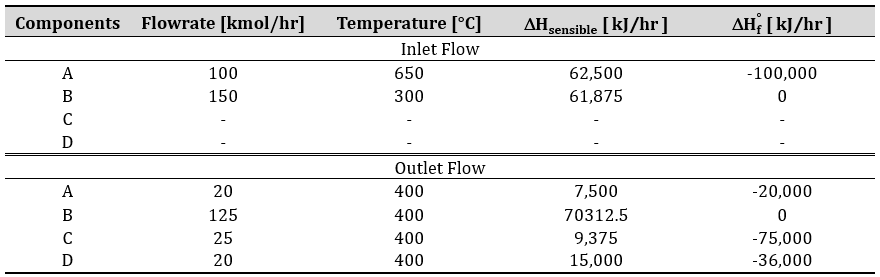
(Table 4.2)
Next, when we calculate the sensible heat and heat of formation for each flow, we get the following results.
The sensible heat of inlet flow: 124,375 kJ/hr
The heat of formation of inlet flow: -100,000 kJ/hr
The sensible heat of outlet flow: 102,187.5 kJ/hr
The heat of formation of outlet flow: -131,000 kJ/hr
Now, by substituting the obtained value into (Eq 4.5), we can calculate the heat of reaction.
ΔHrxn = 102,187.5 – 124,375 + (-131,000) – (-100,000) = -53,187.5 kJ/hr
Case 2: If the reactor operates as an adiabatic system (Q = 0), what is the expected temperature of F3?
Assuming the temperature of F3 as T, we can organize the information as follows.

(Table 4.3)
The sensible heat of inlet flow: 124,375 kJ/hr
The heat of formation of inlet flow: -100,000 kJ/hr
The sensible heat of outlet flow: 272.5 [T – 25°C] kJ/hr
The heat of formation of outlet flow: -131,000 kJ/hr
Since it is a steady state, the accumulation value is zero. So, we can perform the calculation as follows.
{124,375 + (-100,000)} – {272.5 [T – 25°C] + (-131,000)} = 0
272.5 [T – 25°C] = 155,375 kJ/hr
∴ T ≒ 595.2 °C
Nomenclature
CP : heat capacity of component i
EK,i: kinetic energy of component i
EP,i: potential energy of component i
ΔH°f : standard heat of formation
ΔH°rxn : standard heat of reaction
Q : heat
T : temerature
U : internal energy
vi : stoichiometry coefficients of component i
W : work
λi : latent heat of component i
ξ : extent of reaction