Episode 02. Mass Balance with Reaction
Summary
We often encounter processes with chemical reactions. In the presence of a reaction, materials are generated or consumed before and after the reaction, so information related to the reaction is necessary when calculating mass (or material) balance. In this episode, we explore information about chemical reactions and then discuss how to calculate mass balance with reactions through examples.
1. Introduction
The previous episode discussed the mass(or material) balance without reaction. However, in some processes, reactions occur, especially in reactors. When reactions occur, some substances are consumed or generated before or after the reaction, and it’s essential to consider this when calculating the mass balance. Before calculating the mass balance, we need information about the reaction, such as the chemical equation, conversion ratio, and selectivity. The chemical reaction shows us which components will be generated and consumed during the reaction. The conversion ratio indicates how much of the reaction occurs. Selectivity refers to the ratio of different products when reactants participate in multiple reactions. By using this information, we can calculate the “mass balance with reaction” (molar basis rather than mass basis).
2. Information about Reaction
As mentioned, we need information about the reaction before calculatung the mass balance. Therefore, let’s take a closer look at some of the information related to the reaction.
Chemical equation
\( {\small\displaystyle\begin{align} aA \, + \, bB \quad\longrightarrow\quad cC \,+\,dD \tag*{} \end{align} } \)
The equation above is a general reaction equation. To complete the chemical equation, we need to know the reactants (A, B) and products (C, D) and calculate the stoichiometric coefficient (a, b, c, d) of each chemical equation. Stoichiometry calculations are based on the principle that atoms cannot be created or destroyed in a chemical reaction. In other words, although the components may change before and after the reaction, the number of atoms remains the same. Stoichiometric coefficients(vi) for reactants are negative, and those for products are positive. Applying this to the general reaction equation, we can express it as follows:
\( {\small\displaystyle\begin{align} v_A \, = \, -a \qquad v_B\,=\,-b \qquad v_C\,=\,c \qquad v_D\,=\,d \tag*{} \end{align} } \)
Example) The complete combustion of methane with oxygen produces carbon dioxide and water.
The reactants in the example are methane and oxygen. The products are carbon dioxide and water. The equation can be expressed as:
\( {\small\displaystyle\begin{align} aCH_4 \, + \, bO_2 \quad\longrightarrow\quad cCO_2 \,+\, dH_2O \tag*{} \end{align} } \)
Now, we calculate stoichiometry. The atoms in the reaction are carbon(C), hydrogen(H), and oxygen(O). Since the number of atoms does not change before and after the reaction, we can establish equations for each atom.
\( {\small\displaystyle\begin{align} a \quad &=\quad c \tag{based on C} \\[15pt] 4a \quad &=\quad 2d \tag{based on H} \\[15pt] 2b \quad &=\quad 2c \, + \, d \tag{based on O} \end{align} } \)
Assuming a equals 1, solving the equation gives a = 1, b = 2, c = 1, and d = 2. Therefore, the reaction equation is as follow:
\( {\small\displaystyle\begin{align} CH_4 \, + \, 2O_2 \quad\longrightarrow\quad CO_2 \, + \, 2H_2O \tag*{} \end{align} } \)
Extent of Reaction, ξ
“Extent of reaction” is a value that can know the degree to which a reaction occurs. It is obtained through (Eq 3.1). Based on the extent of reaction, it is possible to determine which reactants are limiting or excess reactants. To know this, we need to calculate the maximum extent of reaction for each reactant. The maximum extent of reaction is the value obtained when each reactant is assumed to react completely (nf = 0). The reactant with the smallest value is the limiting reactant and others are excess reactants.
\( {\small\displaystyle\begin{align} \xi \quad &= \quad \frac{n^f_i\,-\,n^i_i}{v_i} \tag{Eq 2.1} \\[15pt] \xi^{Max} \quad &= \quad \frac{-\, n^i_i}{v_i} \tag{Eq 2.2} \end{align} } \)
\( {\small\displaystyle\begin{align} \qquad n^f_i\,&:\, \text{Moles of component i after reaction} \\[15pt] \qquad n^i_i\,&:\, \text{Moles of component i before reaction} \end{align} } \)
Conversion ratio, X
In some cases, not all of the limiting reactants react completely, but only a portion of them react. In this case, we check the conversion ratio to calculate the amount of reactants and products. The conversion ratio is a value that can determine how much of the limiting reactant has participated in the reaction. It can be calculated in two ways:
The first is the ratio of moles of reactant that react to moles of the reactant fed. The second method is to calculate the ratio of the actual extent of reaction to the maximum extent of reaction.
\( {\small\displaystyle\begin{align} Conversion\,ratio,\,X_i \quad &=\quad \frac{\text{Moles of i that react}}{\text{Moles of i fed}} \tag{Eq 2.3} \\[10pt] &or \\[10pt] X_i \quad&=\quad \frac{\xi}{\xi^{Max}} \tag{Eq 2.4} \end{align} } \)
Selectivity, S
\( {\small\displaystyle\begin{align} Reaction\,1\,: \qquad &aA \,+\, bB \quad \longrightarrow \quad F\,(desired) \\[15pt] Reaction\,2\,: \qquad &\alpha A \quad \longrightarrow \quad G\, (undesired) \tag*{} \end{align} } \)
Some reactants can participate in several reactions at the same time, not just one reaction. In this case, we use “selectivity” to calculate the amount of product. Selectivity is expressed as a ratio of the amount of desired product to the amount of undesired product. More precisely, selectivity is defined as the ratio of reaction rates between the desired and undesired products, but further details will be covered in another episode.
\( {\small\displaystyle\begin{align} Selectivity,\,S \quad& = \quad \frac{\text{Moles of desired product}}{\text{Moles of undesired product}} \tag{Eq 2.5} \end{align} } \)
3. How to calculate "Mass balance with Reaction"?
So far, we have discussed information related to reactions. Now let’s calculate the mass balance with reaction based on this information. Do you remember (Eq 1.1) from Episode 01? The mass balance with reaction also uses the equation. In the episode’s example, the igeneration term was 0, but now we have to consider this term. The igeneration value can be obtained through the stoichiometric coefficient and extent of reaction we mentioned above. Through (Eq 2.1), we can know that the extent of reaction multiplied by the stoichiometry is the amount generated or consumed by the reaction. Now we can use (Eq 1.1) to formulate the mass balance for each component in the reaction equation.
\( {\small\displaystyle\begin{align} i_{in} \, - \, i_{out} \, + \, i_{generation} \quad = \quad i_{accumulation} \tag{Eq 1.1} \end{align} } \)
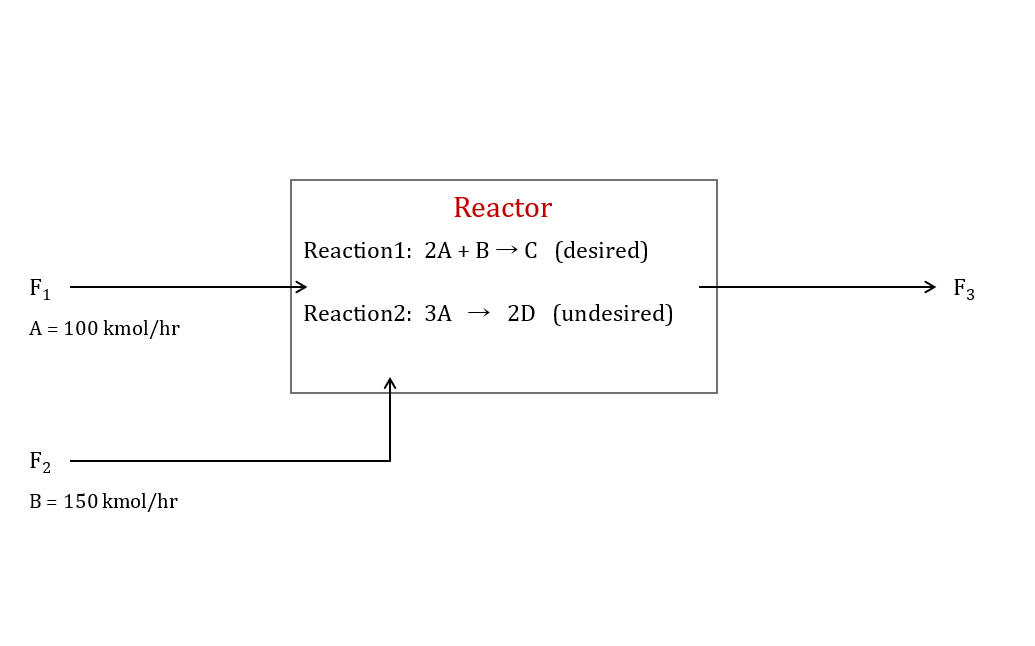
Let’s calculate the compositions of F3 in (Figure 2.1) by applying the mass balance to each case. There is no accumulation in any of the cases (=iaccumulation is 0).

(Figure 2.1)
Case 1 : Single Reaction (only Reaction 1, Conversion ratio : 0.8)
First, we need to identify the limiting reactant. The maximum extent of reaction of A is 50, and for B is 150. Therefore, the limiting reactant is A. Since the conversion ratio is 0.8, the extent of reaction value is 40.
– Maximum extent of reaction, ξMax
ξMax (based on A) : ( – 100)/(- 2) = 50
ξMax (based on B) : ( – 150)/(- 1) = 150
Based on (Eq 1.1) and the above information, it can be organized as (Table 2.1). F3 consists of iout values of each component. Therefore, the components of F3 are A : 20 kmol/hr, B : 110 kmol/hr, and C : 40 kmol/hr.
| Reaction | \( 2A \quad+\quad B \quad\longrightarrow\quad C \) | ||
|---|---|---|---|
| Component | A | B | C |
| iin [kmol/hr] | 100 | 150 | 0 |
| igeneration [kmol/hr] | (-2) X (40) | (-1) X (40) | (1) X (40) |
| iout [kmol/hr] | 20 | 110 | 40 |
Case 2 : Multiple Reaction ( Reaction 1 & 2, Conversion ratio of A : 0.8, Selectivity : 1.25 (moles of C)/(moles of D))
For the convenience of calculation, let us make a few assumptions. Let A1 be the moles of reactant A that can participate in Reaction 1, A2 be the moles of A that can participate in Reaction 2, and 2X be the moles of product D. (Table 2.2) summarizes this information.
| Reaction | 1 | 2 | ||||
|---|---|---|---|---|---|---|
| Reaction equation | \( \displaystyle 2A \quad+\quad B \quad\longrightarrow\quad C \) | \( \displaystyle 3A \quad\longrightarrow\quad 2D \) | ||||
| Component | A | B | C | A | D | |
| iin [kmol/hr] | A1 | 150 | 0 | A2 | 0 | |
| igeneration [kmol/hr] | 2X | |||||
| iout [kmol/hr] | 2X | |||||
– Moles of Product C
By selectivity, Moles of product C : 1.25 x 2X = 2.5X
– Extent of Reaction
ξReaction 1 (based on C) : (2.5X – 0)/(1) = 2.5X
ξReaction 2 (based on D) : (2X – 0)/(2) = X
Now we can fill in the missing information in (Table 2.2) as follows.
| Reaction | 1 | 2 | ||||
|---|---|---|---|---|---|---|
| Reaction equation | \( \displaystyle 2A \quad+\quad B \quad\longrightarrow\quad C \) | \( \displaystyle 3A \quad\longrightarrow\quad 2D \) | ||||
| Component | A | B | C | A | D | |
| iin [kmol/hr] | A1 | 150 | 0 | A2 | 0 | |
| igeneration [kmol/hr] | (-2) x (2.5X) | (-1) x (2.5X) | (1) x (2.5X) | (-3) x (X) | (2) x (X) | |
| iout [kmol/hr] | A1 - 5X | 150 - 2.5X | 2.5X | A2 - 3X | 2X | |
– Conversion ratio of reactant A
We already know the conversion ratio of reactant A. We can use this to set up the equation as follows.
(Moles of A that react) / (Moles of A that supplied) : (5X + 3X)/(A1 + A2) = 0.8
X = 10 kmol/hr (∵ A1 + A2 = 100 kmol/hr)
– Components of F3
A : (A1 – 5X) + (A2 – 3X) = 100 – 8 * 10 = 20 kmol/hr
B : 150 – 2X = 150 – 2.5 * 10 = 125 kmol/hr
C : 2.5X = 2.5 * 10 = 25 kmol/hr
D : 2X = 20 kmol/hr
Nomenclature
ni : moles of component i
nfi : moles of component i after reaction
nii : moles of component i before reaction
S : selectivity
vi : stoichiometry coefficients of component i
X : conversion ratio
ξ : extent of reaction
ξMax : maximum extent of reaction