
Episode 02. Pump Head
Summary
When we check the pump’s performance, we often find the pump’s capacity and head. And when we design a pump system to avoid cavitation, we calculate the NPSH. In this episode, we describe the concept of head, the types of head in the pump, and NPSH.
1. Introduction
Do you remember “Discharge Head” which we mentioned in the previous episode? When we check a pump’s performance, we can find the term “Head”. The head expresses as a unit of length in an existing unit (Pressure or Energy). For example, we often say that 1atm can raise the height of about 10m of water or 760mm of mercury. We can calculate the example through the following process.
\( {\small\displaystyle\begin{align} \text{Head} \quad=\quad \frac{\text{Pressure}}{\text{Density}\times\text{Gravitational acceleration}} \tag*{} \end{align} } \)
\( {\small\displaystyle\begin{align} \circ\,\text{Water}& \\[10pt] &\frac{101.3\;\times\;10^3\;\left[\frac{N}{m^2}\right]} {1,000\,\left[\frac{kg}{m^3}\right]\,\times\,9.8\,\left[\frac{m}{s^2}\right]}\quad =\quad 10.33mH_2O \end{align} } \)
\( {\small\displaystyle\begin{align} \circ\,\text{Mercury}& \\[10pt] &\frac{101.3\;\times\ 10^3\,\left[\frac{N}{m^2}\right]} {13,595\,\left[\frac{kg}{m^3}\right]\,\times\,9.8\,\left[\frac{m}{s^2}\right]} \quad=\quad 0.760m \,=\,760mmHg \end{align} } \)
So why do we use the head in the pump system? Here’s why. First, the head is independent of fluid properties. It means the pump can raise the same height regardless of the fluid’s density. Second, other units it is difficult to estimate its amount. On the other hand, if it expresses in the form of the height of the fluid, it can be intuitively known.
2. Types of Pump Head
There are several heads in the pump system. Since each thing has a different meaning, it is important to distinguish them accurately. The pump head is divided into suction, discharge, and total. Likewise the previous episode, we will use the Bernoulli equation when calculating the pump head.

(Figure 2.1)
– Suction
Let’s look at the head related to the pump suction. The head applied to the suction side of the pump is called Total Suction Head(hts). Through Bernoulli’s equation, the total suction head is following.
\( {\small\displaystyle \begin{align} h_{ts} \quad=\quad \frac{v_s^2}{2g}\,+\,h_s\,+\,\frac{P_s}{\rho g} \tag*{} \end{align} } \)
\( {\small\displaystyle \begin{gather} \frac{\alpha_sv_s^2}{2g}\,+\,(h_s\,-\,h_0)\,+\,\frac{P_s}{\rho g} \quad=\quad \underbrace{\frac{\alpha_Av_A^2}{2g}}_{1)}\,+\, \underbrace{(h_A\,-\,h_0)}_{2)}\,+\, \underbrace{\frac{P_A}{\rho g}}_{3)}\,-\, \underbrace{h_{fs}}_{4)} \tag{Eq 2.1} \\[15pt] 1)\,\text{Velocity head}\quad 2)\,\text{Elevation head}\quad 3)\,\text{Pressure head}\quad 4)\,\text{Friction head} \end{gather} } \)
\( {\small\displaystyle \begin{align} h_{ss} \quad&=\quad (h_A\,-\,h_0)\,+\, \frac{P_A}{\rho g} \tag{Eq 2.2} \\[15pt] h_{ts} \quad&=\quad h_{ss}\,-\,h_{fs}\,+\,h_{v,A} \tag{Eq 2.3} \end{align} } \)
– Discharge
The head applied to the discharge side of the pump is called Total Discharge Head(htd). Before measuremnet, it is also difficult to know directly. So we calculate it like the suction side. The head at the discharge point and point B is the same. So we can get (Eq 2.4) through the modified Bernoulli equation about the two points.
\( {\small\displaystyle \begin{align} h_{td} \quad=\quad \frac{v_d^2}{2g}\,+\,h_d\,+\,\frac{P_d}{\rho g} \tag*{} \end{align} } \)
\( {\small\displaystyle\begin{gather} \frac{\alpha_dv_d^2}{2g}\,+\,(h_d\,-\,h_0)\,+\,\frac{P_d}{\rho g} \quad=\quad \underbrace{\frac{\alpha_Bv_B^2}{2g}}_{1)}\,+\, \underbrace{(h_B\,-\,h_0)}_{2)}\,+\, \underbrace{\frac{P_B}{\rho g}}_{3)}\,+\, \underbrace{h_{fd}}_{4)} \tag{Eq 2.4} \\[15pt] 1)\,\text{Velocity head}\quad 2)\,\text{Elevation head}\quad 3)\,\text{Pressure head}\quad 4)\,\text{Friction head} \end{gather} } \)
And the combination of 2) and 3) in (Eq 2.4) is called Static Discharge head(hsd). Therefore (Eq 2.4) can be rearranged as (Eq 2.6).
\( {\small\displaystyle \begin{align} h_{sd} \quad&=\quad (h_B\,-\,h_0) \,+\, \frac{P_B}{\rho g} \tag{Eq 2.5} \\[15pt] h_{td} \quad&=\quad h_{sd} \,+\, h_{fd} \,+\, h_{vB} \tag{Eq 2.6} \end{align} } \)
– Total
Total Dynamic Head (hTDH) or Total Head is the equivalent height that the fluid coming into the suction side of the pump can be pumped. Perhaps, this is one of the values we want to know when checking the pump’s performance. For calculating the total dynamic head, subtract the total suction head from the total discharge head obtained above. Static discharge head minus Static Suction Head is called Total Static head(hTSH).
\( {\small\displaystyle \begin{align} h_{TDH} \quad&=\quad h_{td} \,-\, h_{ts} \tag{Eq 2.7} \\[15pt] \quad&=\quad (h_{sd}\,-\,h_{ss}) \,+\, (h_{fd}\,+\,h_{fs}) \,+\, (h_{vB}\,-\,h_{vA}) \tag{Eq 2.8} \\[15pt] h_{TSH} \quad&=\quad h_{sd} \,-\, h_{ss} \tag{Eq 2.9} \end{align} } \)
3. NPSH (Net Positive Suction Head)
One of the things to consider when designing a pump system is Net Positive Suction Head(NPSH). To explain NPSH, you must know about cavitation. Cavitation is a phenomenon in which the vaporized fluid collapses and gives a shock to the pump while it is operating. This phenomenon can cause noise, poor pump performance, and damage to the pump. Therefore, we have to avoid cavitation. Why does cavitation occur in the pump?
(Figure 2.2)
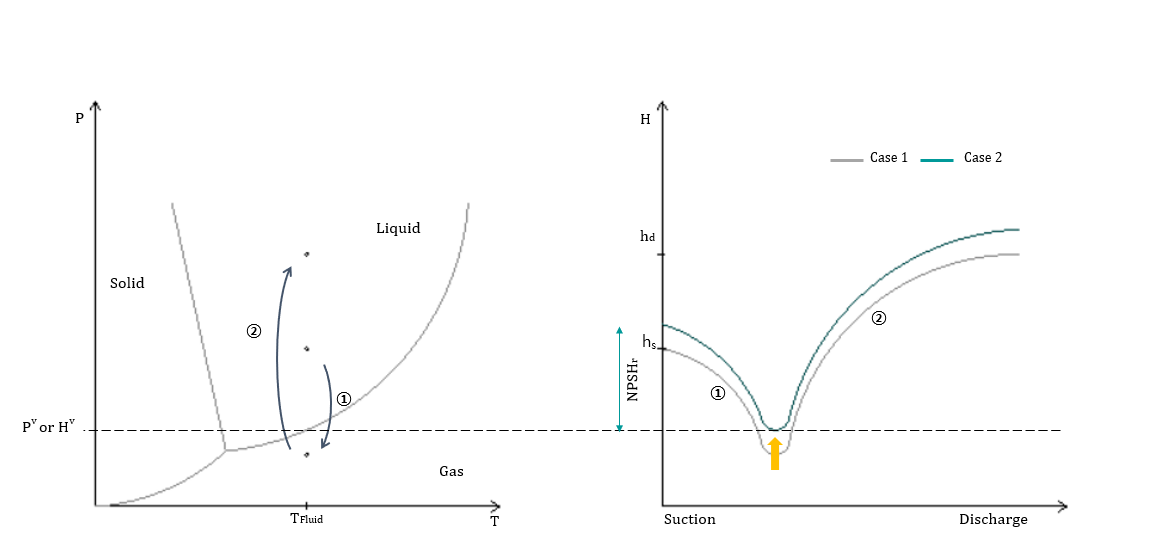
(Figure 2.2) shows the fluid phase diagram (Left) and the fluid head from suction to discharge in the centrifugal pump (Right).
Let’s look at Case 1. After suction, the pressure of the fluid becomes lower than its vapor pressure, and the state of the fluid changes from liquid to gas(➀). Then, the pressure is higher than the fluid’s vapor pressure, and the vaporized fluid becomes liquefied(➁). So, it happens cavitation in the pump. In order to avoid this phenomenon, we have to prevent the pressure (or head) applied to the fluid from being lower than the vapor pressure as in Case 2. We use NPSH to check whether this situation is satisfactory or not. There are NPSHa(NPSH available) and NPSHr(NPSH required).
NPSHa is the difference between the total suction head and the fluid’s vapor pressure. (Eq 2.10) can be obtained by (Eq 2.3). (When point A is the free surface of liquid, the velocity head is 0.) It is determined by the pump suction system regardless of pump type or characteristics.
\( {\small\displaystyle \begin{align} NPSH_a \quad=\quad h_{ss} \,-\, h_{fs} \,-\, h^v \tag{Eq 2.10} \end{align} } \)
NPSHr means the required NPSH value at which cavitation does not occur. NPSHr is independent of the pump suction system. Since the pump’s characteristics and the fluid’s properties determine this value, it must be confirmed by the manufacturer.
As a result, NPSHa calculated based on the designed system must be greater than NPSHr to avoid cavitation. In general, there is a design margin when calculating NPSH. And the amount is determined by each company or project design rule.
\( {\small\displaystyle \begin{align} NPSH_a \,=\, NPSH_r \,+\, \text{Margin} \quad or\quad NPSH_a \,=\, \text{Margin ratio} \,\times\, NPSH_r \tag*{} \end{align} } \)
Nomenclature
\({\small\displaystyle g}\) : gravitational accerlation
\({\small\displaystyle h_f}\) : friction head
\({\small\displaystyle h_{sd}}\) : static discharge head
\({\small\displaystyle h_{ss}}\) : static suction head
\({\small\displaystyle h_{td}}\) : total discharge head
\({\small\displaystyle h_{TDH}}\) : total dynamice head
\({\small\displaystyle h_{TSH}}\) : total static head
\({\small\displaystyle h_{ts}}\) : total suction head
\({\small\displaystyle h_v}\) : velocity head
\({\small\displaystyle h^v}\) : vapor pressure head
\({\small\displaystyle NPSH}\) : net positive suction head
\({\small\displaystyle NPSH_a}\) : NPSH available
\({\small\displaystyle NPSH_r}\) : NPSH required
\({\small\displaystyle P}\) : pressure
\({\small\displaystyle P^v}\) : vapor pressure
\({\small\displaystyle v}\) : velocity
\({\small\displaystyle \alpha}\) : kinetic energy correction factor
\({\small\displaystyle \rho}\) : density